Tarot reading is generally full of mystery; for some it is a means of forecasting the future, whereas for others it serves as a tool for reflection, developing one’s intuition, and providing personal guidance. In fact, Tarot can be looked at in a far more meaningful manner.
When we are uncertain about life, it is natural to seek answers. Should I go for this opportunity? Is this relationship suitable for me? Why am I feeling stuck? What course should I now follow?
A careful Tarot reading can offer a new way of looking at such questions; instead of making up your mind for you, it can assist you in examining your thoughts, feelings, situations, and the various courses open to you with greater awareness.
In this guide we are going to look at what Tarot reading is, examine how it works, consider the different kinds of readings that are available, and see how Tarot can be used as a supportive tool for achieving personal clarity.
What Is Tarot Reading?
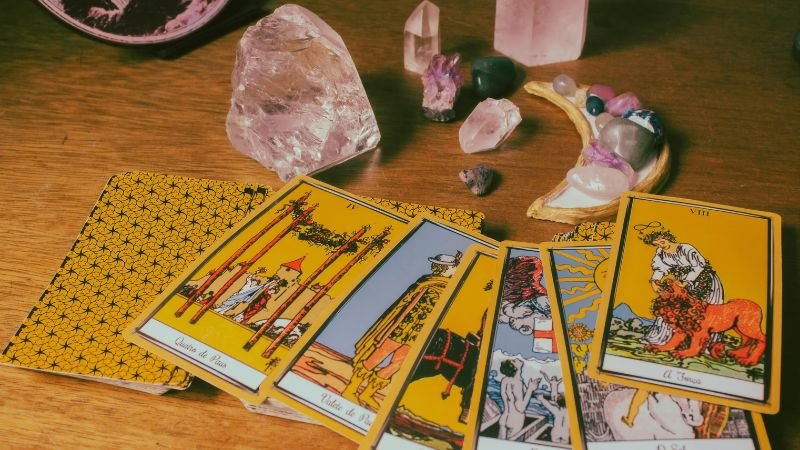
Tarot is a set of cards which have traditionally been used for symbolic interpretation and for providing intuitive guidance.
A standard Tarot deck contains 78 cards, divided into two major groups:
- Major Arcana
- Minor Arcana
Each card has its own unique imagery and symbolism; when a reading is being done the cards are placed in a specific pattern known as a spread and the reader interprets them in relation to the question, the position, the cards surrounding it and the overall context.
The fixed meaning of a Tarot card is not necessarily the case; the card’s interpretation may vary according to the question and the particular circumstances of the person getting the reading.
It is for this reason that Tarot becomes a very personal practice.
Is the Tarot concerned with predicting the future?
This is most likely the question that people ask.
Tarot must not be regarded as a definite prediction of a future that is fixed.
The course of your life is affected by a great many factors such as the choices you make, the actions you take, the relationships you have, the circumstances you find yourself in, and the opportunities that come your way.
Rather, the Tarot can be used to examine the present energies, possibilities, patterns, and perspectives.
Picture it as a mirror not a crystal ball.
A reading might enable you to identify something that you have already intuitively understood but have just been unable to put into clear terms.
How is a tarot reading carried out?
A typical Tarot reading starts off with a discussion.
You can either pose a specific question or just explain the area of your life in which you are uncertain.
For example:
- I don’t know what career path to take.
- Shoul dI take up this new opportunity?
- What is the reason why I am having trouble in my relationship?
- What should I do next?
- What then should I concentrate on in this stage of my life?
The reader then selects a suitable spread and gives their interpretation of the cards in relation to your situation.
The aim is to have a significant discussion regarding the symbolism and insights that are revealed in the reading.
Major Arcana and Minor Arcana
The way in which the Tarot deck is structured means that one can better understand how readings function.
Major Arcana
The 22 cards which make up the Major Arcana stand for important themes, experiences, lessons, and transitions.
The Fool, The Magician, The Lovers, The Hermit, Death, The Star, and The World all have strong symbolic meanings.
They are frequently linked with the various stages involved in personal development and transformation.
For example, The Hermit is usually linked with introspection, wisdom, and the practice of taking time to look within.
The Star is frequently associated with hope, inspiration, healing, and a renewed sense of optimism.
The symbolic meanings can be particularly significant when viewed in the context of the person’s question.
Minor Arcana
The 56 cards in the Minor Arcana are divided into four suits.
The cards are frequently linked with ordinary experiences, emotions, decisions, difficulties, relationships, and practical situations.
The four suits are traditionally known as:
- Wands
- Cups
- Swords
- Pentacles
Every suit looks at a different aspect of life.
Tarot for Love and Relationships
One of the most frequent reasons why people turn to Tarot for advice is relationship issues.
It is often hard to look at a situation in an objective way when emotions are a factor.
A Tarot reading can encourage reflection on questions such as:
- What is going on in this relationship?
- What emotional patterns are having an effect on us?
- What do I need to know regarding this situation?
- What is the best way of communicating more effectively?
- What then should I concentrate on when it comes to my personal growth?
What we want to do is not to make up our minds for either of the people.
Rather, the Tarot can enable you to understand the situation from a different point of view and spot the areas that might warrant attention.
Tarot for Career Decisions
Career choices can also lead to a great deal of uncertainty.
You could be thinking about changing jobs, about opening your own business, about taking up a new skill, or about deciding between various opportunities.
Tarot can be used to explore:
- Current career energy
- Possible opportunities
- Concerns or obstacles
- Your mindset toward the situation
- Areas that require greater attention
- Potential directions worth exploring
A reading cannot take the place of practical career planning; on the contrary, it can assist your own thoughts by prompting you to look at the situation from a different point of view.
Tarot for Personal Clarity
Sometimes you do not have a specific question.
You simply feel stuck.
You might be aware that a change is necessary, but you won’t know what exactly should change.
A general Tarot reading can be very useful here.
Instead of focusing on one prediction, the reading can explore themes such as:
- What ought I to concentrate on at the moment?
- What am I overlooking?
- What patterns are preventing me?
- What should I focus my energy on?
- What should I learn from my present situation?
Instead of relying on predictions, these questions promote self-reflection.
Understanding Reversed Tarot Cards
In most Tarot traditions the cards may appear in an upright position or in a reversed one.
The fact that a card is reversed doesn’t mean that it has a negative significance.
Depending on the reading, it may represent:
- Internal energy
- Delayed progress
- A lesson that needs attention
- A different expression of the card’s energy
- Something that may require reflection
The significance of the meaning is determined by the other cards and by the context of the reading.
This is yet one more reason why it will not give an accurate interpretation of a full reading to merely look up the meaning of a single Tarot card.
How Tarot Can Support Decision Making
When we are confronted with a difficult decision, we usually concentrate on the result that we desire.
It can make it hard to identify our fears, assumptions, and emotional biases.
A Tarot reading will cause you to slow down and look at the situation more carefully.
For example, instead of asking:
Shall I secure this position?
you might ask:
What then should I understand regarding this career opportunity?
The second question provides more room for reflection.
It enables you to consider your motivations, worries, responsibilities, and the various steps you might take next.
Tarot and Intuition
One of the most interesting features of Tarot is the way it relates to intuition.
Intuition refers to the capacity of recognizing or understanding a thing without having to consciously examine each detail.
Tarot symbols can cause people to take notice of the feelings and thoughts which they would usually ignore.
The cards serve as a starting point for reflection.
At times a specific image or symbol will immediately bring to mind something that has occurred in your life.
The individual’s reaction may then take on a significant role in the discussion.
Can Tarot and Vedic Astrology be used together?
Tarot and Vedic Astrology are different systems, yet some people use them together since they act as complementary methods of guidance.
Vedic Astrology takes into account the positions of the planets, birth charts, the houses, the signs, the Nakshatras, and the planetary periods.
The tarot mainly functions by means of symbolism, imagery, intuition, and the context of the question.
They can provide various points of view if used responsibly.
While astrology can offer a more comprehensive insight into life patterns and timing, Tarot can be used to examine the emotional and situational aspects of a particular question.
At what stage should you think about having a tarot reading?
You needn’t be going through a serious crisis in order to look into Tarot.
A reading may be helpful when you are:
- Facing an important decision
- Experiencing relationship uncertainty
- Considering a career change
- Feeling emotionally confused
- Beginning a new chapter
- Looking for a fresh perspective
- Exploring personal growth
- Seeking greater self-awareness
The best thing to do is to read with an open mind rather than anticipating a fixed answer.
How to Prepare for a Tarot Consultation
Special preparation isn’t necessary.
Nevertheless, taking a few simple steps can turn your experience into a more meaningful one.
Choose a Clear Question
Rather than posing many unrelated questions at the same time, start with the one area that is most important to you.
Be Honest
The more honestly you describe your present circumstances, the simpler it becomes to understand the reading within a meaningful context.
Keep an Open Mind
You can gain an insight which will contradict your present expectations.
See in it an opportunity for reflection rather than something that you have to accept right away.
Take Notes
Sometimes, important insights can be made clearer as a result of having a consultation. It may be helpful to keep a journal in order to reflect on what you have learned.
What Tarot Cannot Do
Guidance from the Tarot, when it is responsible, must never lead to fear or dependence.
Tarot cannot replace:
- Medical professionals
- Mental health professionals
- Financial advisors
- Legal professionals
- Practical decision-making
A Tarot reading must be viewed as a kind of personal and spiritual guidance and not as professional advice in those areas where qualified specialists are needed.
How Anjali Chattopadhyay Approaches Tarot Guidance
The book entitled Tarot Guidance by Anjali Chattopadhyay treats this as a means of obtaining clarity and a new perspective.
What is emphasized is not the intention to cause fear or making firm promises regarding the future.
What the readings instead seek to do is to enable you to come to an understanding of your present situation, consider different points of view, and reestablish contact with your own intuition.
If you are dealing with a choice about your career, doubts regarding a relationship, experiencing emotional confusion, or just wanting some guidance, personalized Tarot advice can offer you a thoughtful opportunity for reflection.
Final Thoughts
The future is not simply something that happens to us.
Our choices, awareness, actions, and willingness to grow all influence the journey ahead.
Tarot can become a meaningful tool for that journey—not because it gives every answer, but because it encourages us to ask better questions.
Sometimes clarity does not come from being told exactly what to do.
It comes from seeing your situation from a new perspective.
If you’re feeling uncertain about your next step, Tarot Guidance can offer a calm space to reflect, reconnect with your intuition, and explore the possibilities that lie before you.
The cards may offer the symbols, but the choices remain yours.